

Oxidized Bitumen 90/15 – Blown Bitumen Supplier
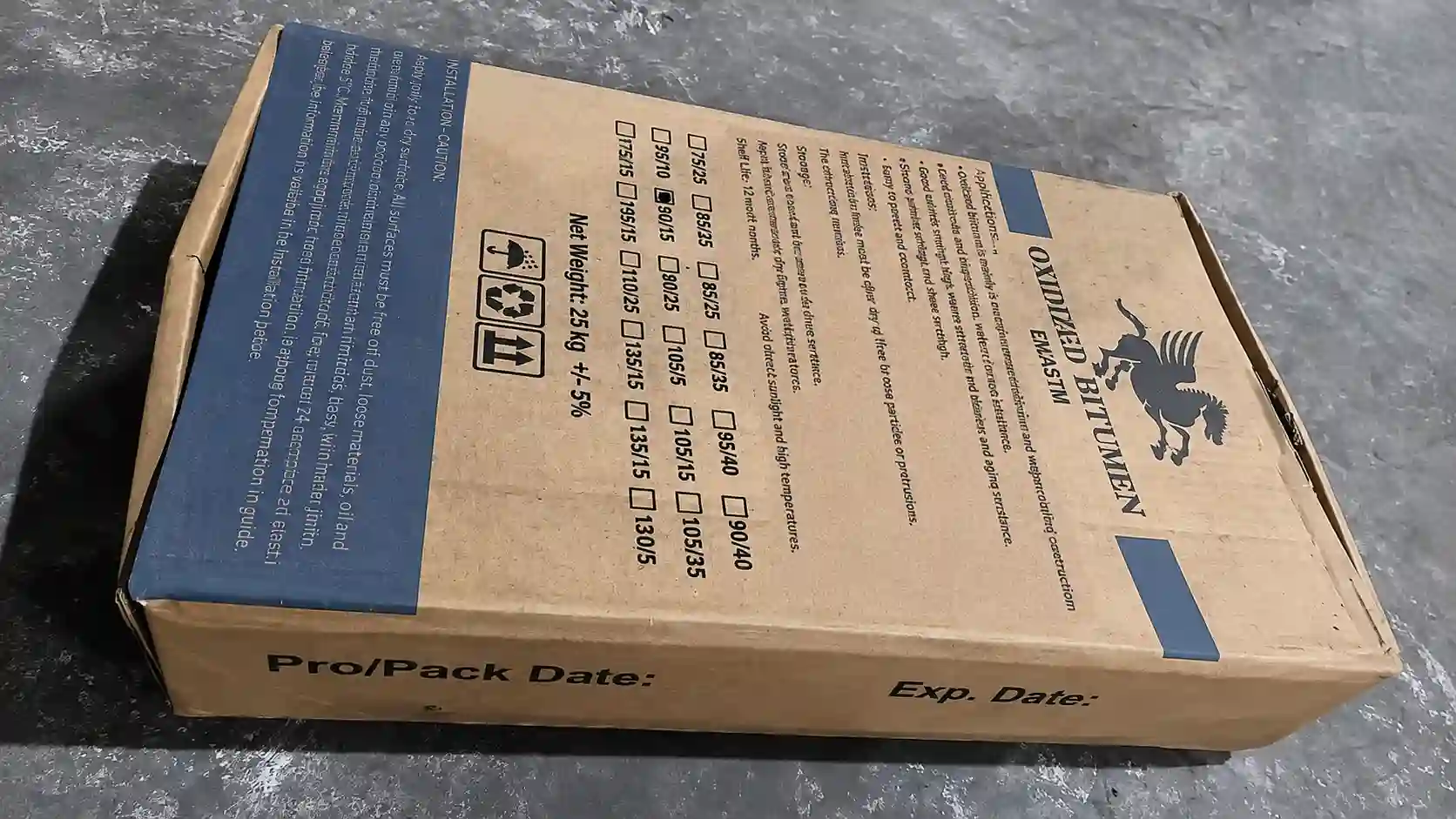
Oxidized Bitumen 90/15 is a blown bitumen grade made through controlled air oxidation of penetration-grade bitumen. Manufacturers heat the base bitumen and pass air through it under carefully managed conditions. This process raises the softening point and lowers penetration, which creates a harder, more temperature-stable material. As a result, Oxidized Bitumen 90/15 performs well in applications that demand stability under heat and mechanical stress.
Unlike standard penetration bitumen, which stays relatively soft and flexible, oxidized asphalt resists flow at elevated temperatures. Because of this property, manufacturers and contractors widely use Oxidized Bitumen 90/15 in waterproofing membranes, roofing compounds, pipe coatings, and industrial sealants. This page explains the technical specifications, key properties, applications, and sourcing considerations that buyers need before purchasing this grade.
What Is Oxidized Bitumen 90/15?
Oxidized bitumen, also called blown bitumen or air-blown bitumen, starts as straight-run penetration bitumen. Refiners then subject this base material to a controlled air-blowing process at elevated temperature. During this process, oxygen reacts with the bitumen and increases its molecular weight. Consequently, the material becomes harder, firmer, and more resistant to temperature swings.
Conventional penetration-grade bitumen remains relatively soft and temperature-sensitive. It flows more easily under heat and offers limited resistance to deformation. Oxidized Bitumen 90/15, in contrast, maintains its shape and consistency across a wider temperature range. For this reason, manufacturers select oxidized grades for applications where thermal stability matters more than flexibility.
The “90/15” designation refers to two typical parameters. The first number relates to the softening point, and the second number relates to the penetration value. Together, these figures indicate a harder, higher-melting bitumen compared with standard paving grades. In practical terms, this makes Bitumen 90/15 suitable for roofing, waterproofing, and industrial uses rather than road construction.
Physically, Oxidized Bitumen 90/15 typically appears as a dark brown to black solid at room temperature. It softens and becomes workable once heated. Controlled oxidation improves cohesion, reduces temperature sensitivity, and increases resistance to flow. This combination explains why the grade performs reliably in demanding industrial environments.
Oxidized Bitumen 90/15 Specifications
The table below outlines typical technical characteristics associated with Oxidized Bitumen 90/15. These figures represent general industry ranges for this grade and do not constitute a guaranteed product specification. Buyers should always request the official Oxidized Bitumen 90/15 TDS and Certificate of Analysis for confirmed, batch-specific values.
| Parameter | Typical Value | Test Method |
|---|---|---|
| Softening Point (Ring & Ball) | Typically 85–95°C | ASTM D36 / IP 58 |
| Penetration (25°C, 100g, 5s) | Typically 10–20 (1/10 mm) | ASTM D5 / IP 49 |
| Ductility (25°C) | Typically 25–50 | ASTM D113 |
| Solubility in Trichloroethylene | Typically 99% minimum | ASTM D2042 |
| Specific Gravity (25°C) | Typically 1.00–1.05 | ASTM D70 |
| Flash Point (Cleveland Open Cup) | Typically 230°C minimum | ASTM D92 |
| Loss on Heating | Typically 0.2–0.8% | ASTM D6 |
Many oxidized bitumen grades, including 90/15, are commonly referenced against standards such as the ASTM specification for asphalt used in built-up roofing. However, buyers should confirm the exact Oxidized Bitumen 90/15 ASTM specification and applicable test methods directly with the supplier before placing an order, since values can vary slightly between production batches.
Key Properties of Oxidized Bitumen 90/15
Oxidized Bitumen 90/15 offers a distinct property profile compared with penetration-grade bitumen. In particular, the following characteristics stand out.
High softening point. The oxidation process raises the softening point significantly. As a result, the material stays firm and stable even in warm conditions.
Improved temperature resistance. Because oxidation reduces temperature sensitivity, Oxidized Bitumen 90/15 performs consistently across a broader temperature range than standard bitumen.
Good adhesion. The material bonds well to substrates such as concrete, metal, and various construction surfaces, which supports its use in coatings and waterproofing systems.
Water resistance. Bitumen is naturally hydrophobic, and the oxidized structure reinforces this property. Consequently, it forms an effective barrier against moisture penetration.
Durability. The denser molecular structure created during oxidation supports long-term performance in exposed and semi-exposed applications.
Cohesion. Oxidized Bitumen 90/15 holds together well under mechanical stress, which helps it maintain integrity in sealing and jointing applications.
Resistance to flow. Unlike softer bitumen grades, this material resists sagging or flowing at elevated service temperatures.
Stability in demanding applications. Taken together, these properties make Oxidized Bitumen 90/15 a practical choice for industrial settings that require dependable, temperature-stable performance.
Applications of Oxidized Bitumen 90/15
Oxidized Bitumen 90/15 supports a wide range of industrial and construction applications. The sections below outline the most common uses.
Waterproofing
Oxidized Bitumen 90/15 plays a central role in many waterproofing systems. Its water resistance and cohesive structure help create effective moisture barriers. For example, manufacturers often incorporate it into waterproofing membranes, coatings, and protective compounds used on foundations, basements, and below-grade structures.
Roofing
Roofing remains one of the most established applications for oxidized asphalt 90/15. Its higher softening point helps roofing compounds resist softening under sun exposure. Similarly, its resistance to flow helps maintain a stable protective layer on flat and low-slope roofing systems.
Pipe Coating
In pipe coating applications, oxidized bitumen can contribute to a protective outer layer that helps shield buried or exposed pipework from moisture and environmental exposure. Because of its cohesive and water-resistant properties, this grade suits coating formulations designed for industrial piping systems.
Sealants and Joint Fillers
Oxidized Bitumen 90/15 also supports the formulation of industrial sealants and joint fillers. Its firmness and resistance to flow help sealed joints maintain their shape under load. In addition, its adhesion properties support long-term bonding in expansion joints and construction seams.
Industrial Coatings
Formulators use oxidized bitumen as a base component in various protective industrial coatings. These coatings often target surfaces exposed to moisture, weathering, or mechanical wear. Because Oxidized Bitumen 90/15 resists deformation, it contributes structural stability to the finished coating.
Insulation and Construction Applications
Within construction, oxidized bitumen supports select insulation and protective board applications where a stable, water-resistant binder is required. While it does not replace dedicated insulation materials, it often works alongside them in composite building products and protective layers.
Only apply Oxidized Bitumen 90/15 in uses appropriate for this grade. Always confirm suitability with a qualified engineer before specifying it for a new application.
Benefits of Oxidized Bitumen 90/15
- Consistent performance across varying temperature conditions
- Good thermal stability compared with standard penetration bitumen
- Strong adhesion to common construction substrates
- Durability suited to long-term industrial and construction use
- Resistance to deformation and flow under load
- Reliable behavior in demanding industrial environments
- Versatility across waterproofing, roofing, coating, and sealant formulations
- Compatibility with standard industrial handling and application methods
Oxidized Bitumen 90/15 Manufacturing Process
Manufacturers produce Oxidized Bitumen 90/15 through a controlled air-blowing process. First, refiners select a suitable penetration-grade bitumen as the base material. Next, they heat this base bitumen to a specific processing temperature.
Once heated, operators pass a controlled stream of air through the bitumen. During this stage, oxygen reacts with the hydrocarbon components in the bitumen. As a result, the material undergoes a structural change that increases its molecular weight and hardness.
Manufacturers monitor the process closely and adjust blowing time, temperature, and airflow to reach the target softening point and penetration values. Because of this careful control, producers can achieve a consistent oxidized grade such as 90/15. In simple terms, the oxidation process transforms a softer, more flexible material into a firmer, more temperature-resistant product suited to industrial and construction use.
Packaging, Storage, and Handling
Suppliers commonly offer oxidized bitumen in several packaging formats, depending on buyer requirements and shipping method. Common options across the industry include:
- Kraft paper bags
- Poly bags
- Carton packaging
- Melting bags for direct use
- Steel drums
- Bulk packaging for large-volume orders
Buyers should confirm available packaging formats directly with their chosen supplier before ordering, since options vary by producer and order size.
Proper storage protects product quality. Store Oxidized Bitumen 90/15 in a cool, dry, well-ventilated area, away from direct sunlight and excessive heat. In addition, keep the material away from moisture and contamination sources. Stack packaged bitumen carefully to avoid deformation or damage, particularly in warmer climates where softening can occur at elevated ambient temperatures. During handling, use appropriate protective equipment, since heated bitumen can cause burns and requires careful, trained handling.
Oxidized Bitumen 90/15 Supplier and Exporter
Selecting the right Oxidized Bitumen 90/15 supplier directly affects project outcomes and long-term operational reliability. Therefore, buyers should evaluate several factors before committing to a purchase.
Consistent quality. A dependable Oxidized Bitumen 90/15 manufacturer maintains stable production practices, which helps ensure batch-to-batch consistency.
Technical documentation. Reliable suppliers provide supporting documents, including a Technical Data Sheet, Certificate of Analysis, and Safety Data Sheet, so buyers can verify the material before use.
Quality control. Established quality control procedures help confirm that each shipment meets the agreed technical parameters.
Packaging options. A capable Oxidized Bitumen 90/15 exporter typically offers multiple packaging formats to suit different transport and storage needs.
International shipping experience. For cross-border orders, suppliers should demonstrate familiarity with export documentation, logistics, and shipping requirements.
Reliable communication. Clear, responsive communication supports smoother ordering, order tracking, and after-sales support.
Bulk order capability. Industrial buyers, contractors, and distributors often require flexible order volumes, from trial quantities to full bulk shipments.
When comparing an Oxidized Bitumen 90/15 price from different sources, buyers should weigh documentation, consistency, and service quality alongside cost.
Request a Quote
Are you sourcing Oxidized Bitumen 90/15 for a construction project, manufacturing operation, or distribution business? Our team can provide the technical and commercial information you need to move forward with confidence.
Contact us to request:
- Current pricing
- Technical Data Sheet (TDS)
- Certificate of Analysis (COA)
- Safety Data Sheet (SDS)
- Packaging details
- Minimum order quantity (MOQ)
- Delivery timelines
- Shipping and logistics options
Whether you need a trial shipment or a recurring bulk supply arrangement, reach out today, and our team will respond with the documentation and support required for your evaluation and purchasing process.
FAQ about Oxidized Bitumen 90/15
Oxidized Bitumen 90/15 is a blown bitumen grade produced through controlled air oxidation of penetration-grade bitumen. The process increases hardness and improves temperature stability compared with standard bitumen grades.
The numbers refer to typical softening point and penetration characteristics associated with this grade. In general, "90" relates to the softening point range and "15" relates to the penetration value.
Common Oxidized Bitumen 90/15 applications include waterproofing systems, roofing compounds, pipe coatings, industrial sealants, protective coatings, and select construction products.