

Bitumen MC 70 – Properties, Applications, Specifications and Supplier Guide
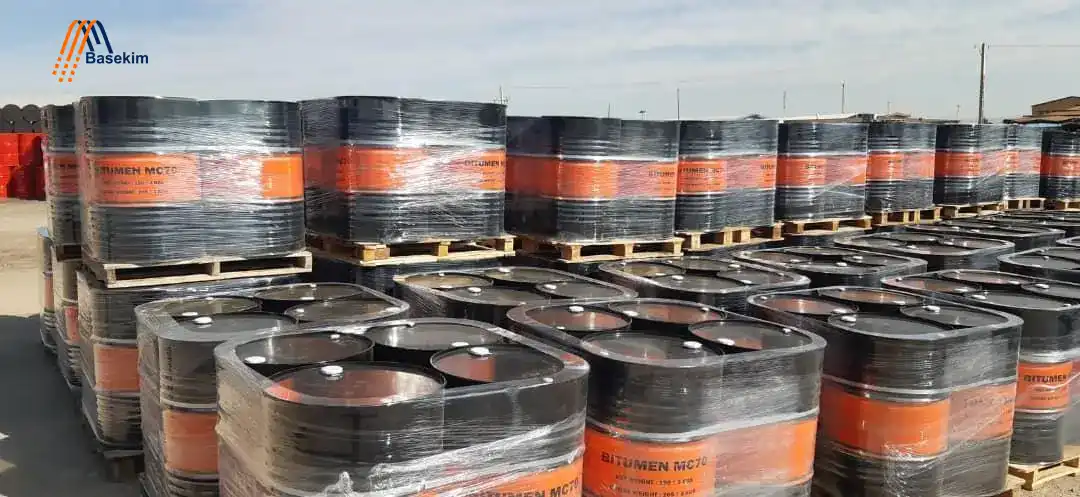
Bitumen MC 70 is a medium-curing cutback bitumen widely used in road construction, pavement preparation, prime coating, and asphalt maintenance projects. Contractors choose this grade because it offers controlled viscosity, strong surface penetration, reliable adhesion, and practical application under different construction conditions.
The product combines paving-grade bitumen with a suitable petroleum solvent. As a result, its viscosity becomes lower than conventional paving bitumen, which allows workers to spray, spread, and apply the material more easily at moderate temperatures. After application, the solvent gradually evaporates while the remaining bituminous binder bonds with the road surface or aggregate.
Because infrastructure projects require consistent performance, buyers should carefully evaluate viscosity, flash point, water content, residue properties, packaging, and supplier reliability before placing an order. Basekim supplies Bitumen MC 70 for international road construction and industrial projects with different packing and shipment requirements.
What Makes Bitumen MC 70 Suitable for Road Construction?
Bitumen MC 70 provides an effective balance between fluidity and curing speed. The “MC” designation refers to medium curing, while the number 70 represents its viscosity classification.
Unlike harder paving bitumen grades, MC 70 flows more easily during application. Therefore, contractors can apply it directly onto prepared road bases without requiring extremely high heating temperatures.
Furthermore, Bitumen MC 70 penetrates porous surfaces effectively. This characteristic makes it especially useful for prime coat applications where the binder must enter the upper layer of an untreated granular base.
Once the material penetrates the surface, the lighter petroleum components begin to evaporate. Consequently, a durable bituminous film remains and improves bonding between the base layer and the next asphalt layer.
Bitumen MC 70 Specifications
Technical specifications may vary slightly according to the applicable standard, refinery, project requirements, and destination market. However, commercial MC 70 normally follows controlled parameters for viscosity, flash point, distillation, water content, and residue quality.
| Property | Typical Requirement |
|---|---|
| Product | Bitumen MC 70 |
| Type | Medium Curing Cutback Bitumen |
| Appearance | Black Viscous Liquid |
| Kinematic Viscosity at 60°C | Approx. 70–140 cSt |
| Flash Point | Typically above 38°C |
| Water Content | Low / Controlled |
| Solubility in Trichloroethylene | Typically ≥99% |
| Curing Type | Medium |
| Main Application | Prime Coat and Road Construction |
| Binder Base | Petroleum Bitumen |
| Diluent | Petroleum Distillate |
| Application Method | Spraying / Distribution |
| Packaging | Drum, Bulk or Project-Based |
Before purchasing, buyers should always request the latest TDS, COA, and applicable test standard for the specific shipment.
Bitumen MC 70 for Prime Coat Applications
Prime coating remains one of the most common applications of MC 70 cutback bitumen.
During road construction, contractors usually apply a prime coat to an untreated granular base before placing the asphalt layer. The prime coat prepares the surface and improves the connection between the foundation and the asphalt pavement.
MC 70 performs effectively in this application because it can penetrate small pores and voids inside the base material.
As a result, the product can:
Bind loose surface particles
Reduce dust formation
Strengthen the upper section of the granular base
Improve adhesion with the next asphalt layer
Reduce rapid absorption of asphalt binder
Prepare the surface for paving operations
However, contractors must apply the correct spraying rate. Excessive application may create a slippery or unstable surface, while insufficient material may fail to achieve proper penetration.
Therefore, engineers normally determine the application rate according to surface texture, absorption capacity, aggregate type, weather conditions, and project specifications.
MC 70 Cutback Bitumen in Pavement Construction
Road construction projects require strong bonding between different pavement layers. Therefore, contractors often select materials that can distribute uniformly across a prepared surface.
MC 70 bitumen supports this process because of its workable viscosity.
A distributor truck can spray the material evenly across the road base. Moreover, the reduced viscosity helps the binder reach surface voids that harder penetration-grade bitumen may not easily enter without extensive heating.
After curing, the remaining bituminous residue forms a stable adhesive layer.
Consequently, MC 70 can contribute to stronger pavement construction when contractors follow proper application, curing, and surface preparation procedures.
Bitumen MC 70 Viscosity
Viscosity represents one of the most important properties of Bitumen MC 70.
The product must remain fluid enough for pumping and spraying while retaining sufficient binder after the solvent evaporates. For this reason, quality control laboratories carefully measure viscosity during production.
The viscosity classification also helps engineers distinguish MC 70 from other medium-curing cutback grades.
For example, the MC family can include grades such as:
MC 30
MC 70
MC 800
MC 3000
As the grade number increases, viscosity generally increases as well. Therefore, MC 70 provides considerably greater fluidity than heavier grades such as MC 800 or MC 3000.
This makes it especially suitable where deeper penetration and easier spraying are required.
MC 70 vs MC 30
Buyers often compare MC 70 vs MC 30 when choosing cutback bitumen for road projects.
Both products belong to the medium-curing category. However, MC 30 normally has lower viscosity and greater fluidity.
Therefore, MC 30 may penetrate highly porous surfaces more easily. In contrast, MC 70 offers somewhat higher viscosity and may provide better control on surfaces where extremely low-viscosity material is unnecessary.
The final selection depends on several factors, including:
Base course porosity
Ambient temperature
Required penetration depth
Road specification
Construction method
Available equipment
Therefore, project engineers should select the grade according to technical requirements rather than price alone.
MC 70 vs MC 250
Another common search among construction buyers is MC 70 vs MC 250.
MC 250 has higher viscosity than MC 70. Therefore, it does not penetrate porous surfaces as rapidly or as deeply under identical conditions.
MC 70 generally works better for applications that require easier spraying and greater penetration. Meanwhile, MC 250 may suit applications requiring a heavier-bodied cutback binder.
Because project conditions differ, contractors should review the required viscosity range and local road authority specifications before selecting either grade.
Advantages of Bitumen MC 70
Bitumen MC 70 offers several practical benefits for infrastructure and road construction projects.
Easy Application
Its lower viscosity allows contractors to pump and spray the product more easily than conventional paving bitumen.
Strong Penetration
MC 70 can enter porous granular surfaces effectively. Therefore, it performs well as a road prime coat.
Good Adhesion
After curing, the remaining binder helps create adhesion between construction layers.
Controlled Curing
The petroleum solvent evaporates gradually. Consequently, workers have enough time to achieve proper distribution and penetration.
Reduced Heating Requirements
Because the product already contains a diluent, application usually requires less heating than conventional high-viscosity paving bitumen.
Practical Surface Preparation
The product can stabilize fine particles and prepare untreated surfaces for subsequent asphalt layers.
Factors Affecting MC 70 Performance
Although product quality matters, application conditions also influence final pavement performance.
Surface Condition
The road base should remain clean and structurally stable. Excessive dust, mud, standing water, or contamination can reduce adhesion.
Temperature
Environmental temperature influences viscosity, evaporation, and curing speed. Therefore, application teams should follow project-specific temperature guidelines.
Application Rate
Using too much or too little MC 70 can reduce the effectiveness of the prime coat. Engineers should determine the correct rate after evaluating the surface.
Curing Time
Contractors should allow sufficient time for volatile components to evaporate before applying the next pavement layer.
Storage Conditions
Proper storage protects material quality and supports safe handling. Tanks and drums should remain away from uncontrolled heat sources and ignition risks.
Bitumen MC 70 Packing
Suppliers can prepare Bitumen MC 70 in different packaging formats depending on order quantity and transportation requirements.
Common options may include:
New steel drums
Bulk tanker shipment
ISO tank shipment
Project-specific industrial packaging
Drum shipment remains practical for many international buyers because it simplifies handling and distribution at the destination.
On the other hand, bulk shipment can offer better logistics efficiency for large road projects with suitable receiving and storage infrastructure.
Therefore, buyers should compare quantity, port facilities, inland transport, storage capacity, and unloading equipment before choosing the packing method.
Storage and Handling of MC 70
Since MC 70 contains petroleum distillates, workers must follow appropriate safety procedures during transportation, storage, and application.
Store the product in properly designed tanks or sealed containers. Additionally, keep it away from open flames, sparks, and uncontrolled ignition sources.
Workers should use suitable personal protective equipment according to the SDS and local workplace regulations.
Furthermore, storage systems must provide adequate ventilation and safe temperature control.
Before using the product, always consult the supplier’s current Safety Data Sheet (SDS/MSDS).
Bitumen MC 70 Price
The Bitumen MC 70 price does not remain fixed because several market factors influence production and export costs.
Important factors include:
Crude oil prices
Base bitumen cost
Petroleum solvent prices
Packaging type
Drum prices
Order quantity
Loading location
Freight rates
Destination port
Incoterms
Currency movements
Therefore, buyers searching for an exact MC 70 price per ton should request a current quotation based on the required quantity and destination.
A supplier may quote the product under terms such as EXW, FOB, CFR, or CIF depending on the shipment.
For an accurate offer, buyers should provide the destination port, quantity, packaging requirement, and required specification.
How to Choose an MC 70 Supplier
Price should not become the only factor when selecting a Bitumen MC 70 supplier.
Instead, buyers should evaluate technical documentation, supply capacity, packaging quality, export experience, and shipment reliability.
Before confirming an order, request documents such as:
Technical Data Sheet
Safety Data Sheet
Certificate of Analysis
Packing details
Country of origin information
Inspection documents when required
Shipping documents
Product photographs
Additionally, confirm whether the supplied material complies with the standard required by your road authority, contractor, or tender documentation.
This verification reduces the risk of receiving unsuitable material for the project.
International Applications of Bitumen MC 70
MC 70 remains relevant in regions where road construction methods allow cutback bitumen.
It may be used in projects involving:
Highway construction
Rural roads
Road rehabilitation
Granular base preparation
Asphalt pavement construction
Infrastructure development
Surface preparation
Prime coating
Road maintenance
Demand often comes from contractors, asphalt companies, road authorities, construction firms, and infrastructure distributors.
However, environmental regulations regarding solvent-containing road binders vary between countries. Therefore, importers should always confirm local regulations before ordering.
MC 70 Transportation
International transportation requires careful planning because cutback bitumen contains volatile petroleum components.
Depending on the quantity and route, exporters may transport the product in approved drums, tankers, or suitable bulk systems.
The supplier and logistics provider should correctly classify the cargo and prepare the required documentation.
Moreover, buyers should check destination-country transportation, storage, environmental, and customs requirements before shipment.
Proper documentation helps reduce delays during customs clearance and cargo handling.
Quality Control
Reliable MC 70 production requires accurate control over both the original bitumen and the petroleum diluent.
Laboratories may evaluate parameters such as:
Kinematic viscosity
Flash point
Distillation characteristics
Water content
Solubility
Residue penetration
Residue ductility
Residual binder properties
These tests help confirm that the product meets the required project specification.
Therefore, professional buyers should review the Certificate of Analysis before accepting large-volume shipments.
Why Contractors Continue to Use MC 70
Although alternative road binders such as bitumen emulsions have gained popularity in many markets, MC 70 still offers important practical advantages in suitable projects.
Its penetration ability, workable viscosity, controlled curing behavior, and proven road construction performance make it useful for specific prime-coating operations.
Furthermore, construction teams already familiar with cutback application equipment can handle MC 70 efficiently when they follow appropriate safety and environmental requirements.
For this reason, the product continues to serve road construction and infrastructure projects in many international markets.
Buying Bitumen MC 70 in Bulk
Bulk buyers should define their technical and commercial requirements before requesting a quotation.
Provide the following information:
Required quantity in metric tons
Destination country
Destination port
Required specification or standard
Preferred packaging
Delivery terms
Required inspection
Expected shipment schedule
Clear information allows the supplier to calculate a more accurate price and propose the most suitable logistics method.
For repeat road projects, buyers may also discuss scheduled shipments to maintain a stable supply during construction.
FAQ – Bitumen MC 70
Bitumen MC 70 is mainly used for prime coat applications, road base preparation, pavement construction, and selected road maintenance projects. Its relatively low viscosity allows it to penetrate porous granular surfaces effectively.
Bitumen MC 70 typically has a kinematic viscosity of about 70–140 cSt at 60°C, depending on the applicable standard and production specification.
MC 30 has lower viscosity and greater fluidity, while MC 70 is slightly thicker. Therefore, MC 30 may penetrate more deeply into highly porous surfaces, whereas MC 70 provides more controlled application.